The world is not flat
AI learned the world from flat pictures. To act in it, a machine needs what a child gets for free: two viewpoints and a hand.
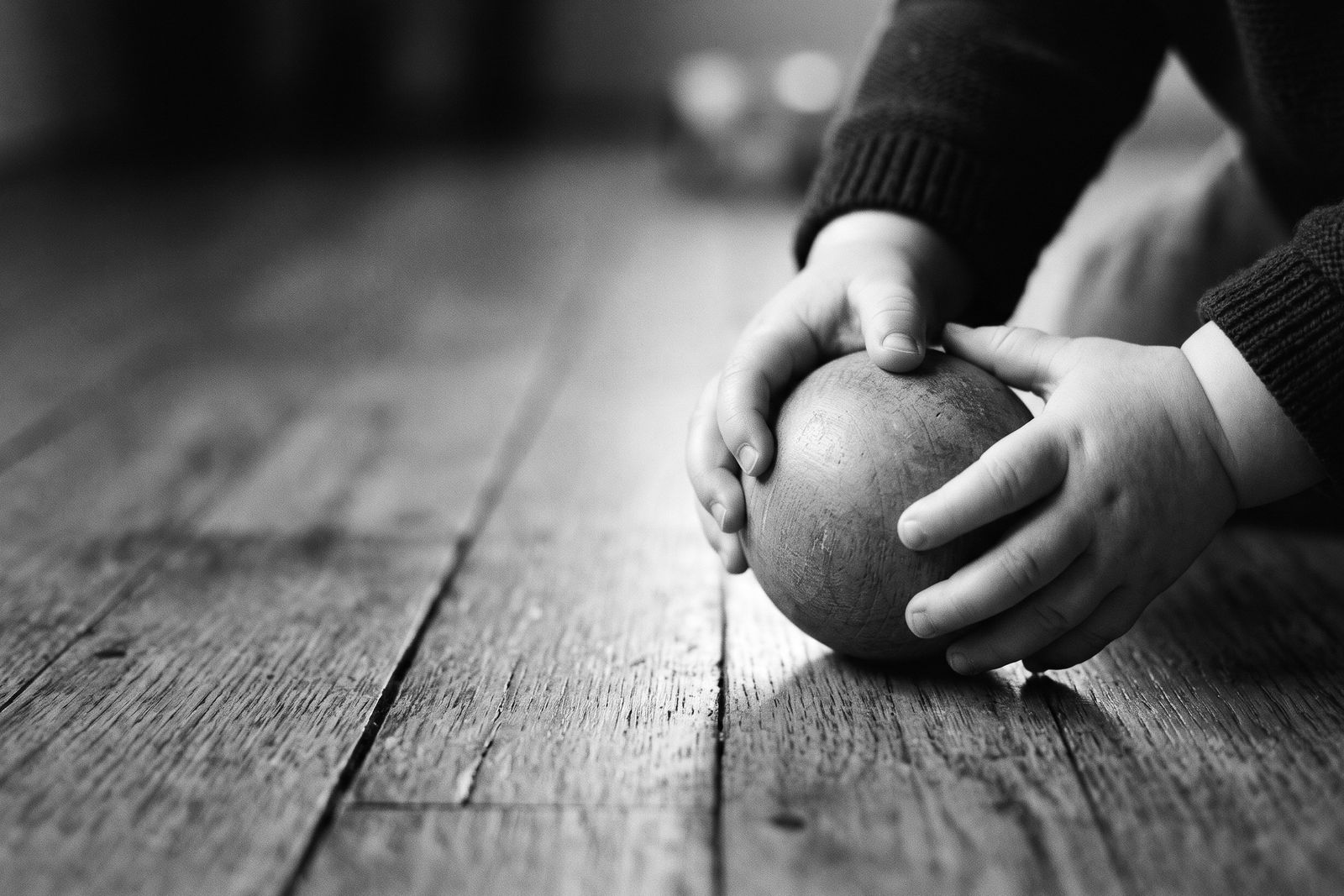
Sixty-three millimetres. That is about the distance between the pupils of an adult. Because of that gap each eye receives a slightly different picture, and the brain turns the difference into depth perception. A photograph keeps one of the two pictures and throws the other away.
Artificial intelligence learned to see from photographs. LAION-5B, an open dataset released in 2022 for training image models, holds 5.85 billion captioned pictures, and every one of them is flat. The industry has since moved on to world models, systems meant to grasp physical space well enough to act in it, and it feeds them the same diet. It is teaching machines about a world they have only ever seen with one eye shut. Then it wonders why a robot fumbles a drawer.
What a photograph discards
A camera is an adding machine. Each pixel sums the light that reaches it through the lens and stores a brightness. The direction each ray came from is lost at that moment, and the geometry of the scene goes with it. A toy car close to the lens and a real one across the street can land on the same pixels.
A light field keeps what the camera adds away. In 1996 Marc Levoy and Pat Hanrahan of Stanford gave the term a working definition: the radiance at a point in a given direction. Record how bright the light is and where it comes from, and the picture keeps its depth.
My own research on depth perception and binocular vision led me to light field technology, with the aim of a true record of the world for future generations. The consumer market had other ideas. Lytro, founded in 2006, sold a light field camera whose party trick was refocusing a snapshot after it was taken, and shut down in 2018. The technology was fine. It had the wrong customer: people with two eyes do not need a camera to tell them where things are, and a machine does.
Depth perception needs a hand
Google DeepMind presented Genie 3 in August 2025 as a general purpose world model and said it could give robots a vast space to train in. It renders its worlds at 720p and 24 frames a second. Whatever the model knows inside, what it shows is a flat picture that moves. Video does hold a second viewpoint whenever the camera travels, but nobody wrote down where the camera went, so that has to be guessed as well.
Psychology ran the decisive experiment in 1963. Richard Held and Alan Hein put ten pairs of kittens in a carousel. One kitten of each pair walked, and the other rode in a gondola that the first one pulled, so both saw the same striped walls for the same three hours a day. The walkers learned to place their paws by sight and chose the shallow side of a visual cliff every time. The riders saw exactly what the walkers saw, and it did them little good.
Seeing, on that evidence, is something an animal does, and watching is a poor substitute. A child gets the full kit for free: two viewpoints and a hand. The eyes tell the hand where to go, and the hand tells the eyes whether they were right. Robot makers know this and bolt depth sensors onto their machines. The models that are supposed to supply the understanding were still raised on flat pictures.
One picture is enough
The reply from the software side is that the missing dimension can be computed back. Monocular depth estimation has become very good. Depth Anything V2, published in 2024, draws a convincing depth map from a single image, and Apple’s Depth Pro returns one with absolute distances in 0.3 seconds. If one eye is enough for a model, the flat archive is no handicap.
Look at how those models were taught. Depth Anything V2 learned from 595,000 synthetic images, rendered from three-dimensional scenes in which the depth of every pixel is known, and its teacher model then labelled 62 million real photographs for the students. The third dimension was in the room all along. Somebody had to supply it.
What the model adds on its own is memory. A single image is ambiguous as a matter of geometry, so the model fills the gap with what doors and chairs usually measure. That works for things it has met before and for pictures meant to be looked at. A photograph of a corridor pinned to a wall sends one fixed eye the same picture as the corridor. A person with one eye settles the matter by moving the head and reaching out, which is my argument in two gestures.
A robot’s work happens in the last few centimetres, where a handle stands proud of a drawer front and fingers have to close on it. A guess that makes a handsome depth map is a poor guide there. Held and Hein’s riders saw every stripe the walkers saw. On the visual cliff they could not tell the deep side from the shallow.
The pictures in this essay were made with AI.